

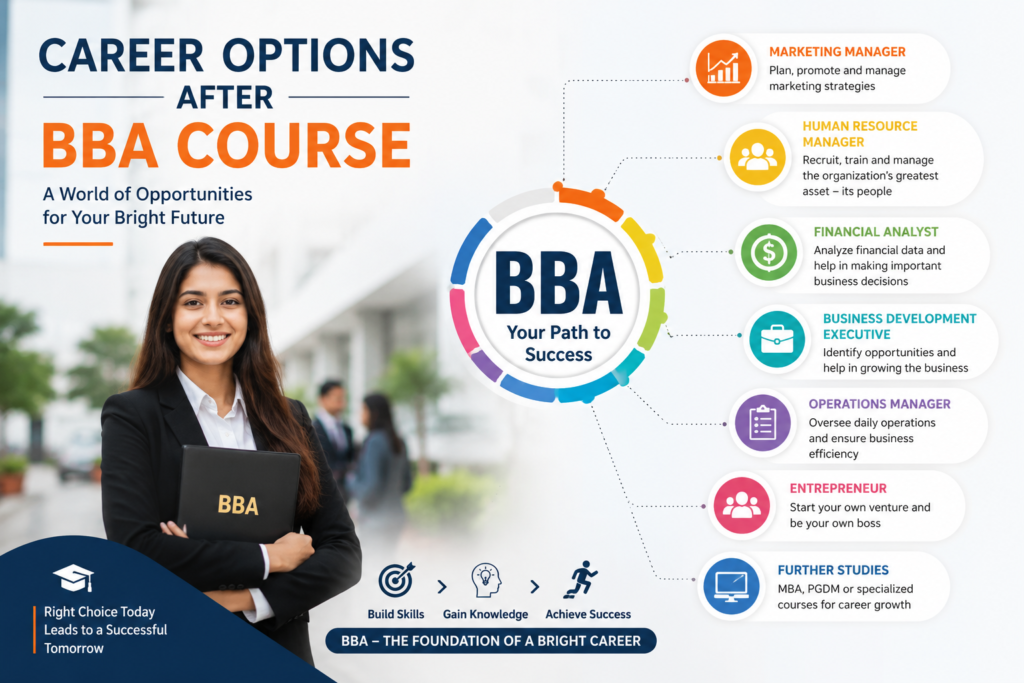
A Bachelor of Business Administration (BBA) is one of the most popular undergraduate programmes for students interested in business, management, finance, marketing, human resources, and entrepreneurship. The course provides students with a broad understanding of how organisations operate while developing communication, leadership, analytical, and decision-making skills.
However, completing a BBA often brings an important question: What should I do after BBA? Should you pursue an MBA, start working, or build your own business?
The answer depends on your career goals, financial situation, interests, skills, and long-term plans. Understanding the different career options after BBA course can help students make a practical and informed decision.
Understanding the BBA Degree
BBA is generally designed to provide students with foundational knowledge of business and management. During the course, students may study subjects such as marketing, accounting, finance, human resource management, business communication, economics, operations, organisational behaviour, and entrepreneurship.
The broad nature of the degree allows graduates to explore multiple career paths. Some students prefer higher education, while others enter the workforce immediately. Students with an entrepreneurial mindset may also use their business knowledge to establish their own ventures.
Let’s explore these three major pathways in detail.
Option 1: Pursue an MBA After BBA
An MBA is one of the most common choices among BBA graduates. A postgraduate management degree can help students develop deeper knowledge of business strategy, leadership, finance, marketing, operations, or other areas of management.
Why Choose an MBA?
An MBA may be suitable for students who want to:
- Develop advanced management skills
- Specialise in a particular business area
- Improve their career prospects
- Move towards managerial positions
- Build professional networks
- Develop leadership capabilities
- Prepare for corporate careers
Depending on the institution and programme, students can choose specialisations such as Marketing, Finance, Human Resources, International Business, Business Analytics, Operations, or Entrepreneurship.
MBA and Career Growth
An MBA can provide a structured pathway for students who want to develop advanced business knowledge. However, students should carefully select their institution and specialisation instead of pursuing an MBA simply because it is considered a conventional option after BBA.
Consider factors such as curriculum, faculty, industry exposure, internships, placement support, alumni network, fees, and the reputation of the institution.
Option 2: Start Working After BBA
Not every BBA graduate needs to pursue postgraduate education immediately. Students can also enter the workforce and gain practical experience.
A BBA provides transferable skills that can be useful in various business functions. Depending on their interests and skills, graduates may explore entry-level positions in:
Marketing
Marketing roles can involve market research, digital marketing, sales support, customer engagement, brand promotion, and business development.
Students interested in communication, creativity, consumer behaviour, and market trends may find marketing a suitable area.
Human Resources
HR professionals help organisations manage their workforce. Entry-level opportunities may include recruitment, employee coordination, HR administration, training support, and employee engagement.
Students who enjoy communication and working with people may consider HR as a career path.
Finance and Accounting
BBA graduates with an interest in finance can explore roles related to financial operations, banking support, accounting assistance, financial services, and business analysis, depending on their qualifications and skills.
Additional certifications or specialised education can help students develop stronger expertise in this field.
Sales and Business Development
Sales and business development are important functions in almost every organisation. These roles can help graduates develop negotiation, communication, relationship-management, and customer-handling skills.
For students who are confident, persuasive, and target-oriented, sales can offer valuable professional experience.
Operations
Operations professionals help organisations manage processes, resources, supply chains, and day-to-day business activities.
Students interested in planning, coordination, logistics, and process management may consider operations-related positions.
Benefits of Working After BBA
Starting a job immediately after graduation offers several advantages:
- Gain practical industry experience
- Earn an income
- Understand workplace culture
- Develop professional networks
- Identify personal strengths and interests
- Build a stronger profile for future education
Some graduates choose to work for a few years before pursuing an MBA. Practical experience can help them understand which management specialisation is most suitable for their career goals.
Option 3: Become an Entrepreneur
Entrepreneurship is another exciting option after BBA. Students who have innovative ideas, leadership qualities, risk-taking ability, and an interest in business creation may consider starting their own venture.
BBA education can provide a basic understanding of areas such as:
- Business planning
- Marketing
- Finance
- Human resources
- Operations
- Customer management
- Business communication
- Entrepreneurship
These skills can be useful when developing and managing a business.
Is Entrepreneurship Right for You?
Starting a business requires more than academic knowledge. Entrepreneurs need adaptability, financial planning, market understanding, problem-solving abilities, persistence, and the willingness to learn from failure.
Before launching a venture, students should research the market, identify their target customers, analyse competitors, prepare a business plan, estimate costs, and understand relevant legal and regulatory requirements.
Starting small can allow new entrepreneurs to test their business model before making significant investments.
BBA Graduates Can Also Explore Government Careers
Students interested in public-sector careers can prepare for competitive examinations after completing their graduation. Depending on eligibility requirements, BBA graduates may be able to appear for various government recruitment examinations.
Government career preparation generally requires dedicated study and preparation in areas such as quantitative aptitude, reasoning, general awareness, English, and other subjects depending on the examination.
Students should always check the official eligibility criteria for the specific examination they intend to pursue.
Develop Skills Alongside Your BBA
Regardless of the career path you select, developing practical skills can significantly improve your professional opportunities.
Some valuable skills for BBA graduates include:
Communication Skills
Effective written and verbal communication is important in almost every business role.
Digital Skills
Knowledge of productivity software, digital marketing tools, business applications, data analysis, and other relevant technologies can improve employability.
Analytical Thinking
Businesses rely on data and information to make decisions. Developing analytical skills can help graduates understand problems and identify practical solutions.
Leadership
Leadership is not limited to managerial positions. The ability to take responsibility, coordinate teams, and make informed decisions is valuable across industries.
Financial Literacy
Understanding basic financial concepts can help students make better business and career decisions.
MBA vs Job vs Entrepreneurship
Choosing between these three options depends largely on your personal circumstances.
Choose an MBA if: you want advanced management education, specialisation, networking opportunities, or a structured path towards management roles.
Choose a job if: you want practical experience, financial independence, and exposure to real business environments.
Choose entrepreneurship if: you have a strong business idea, enjoy taking responsibility, and are prepared to handle uncertainty and risk.
There is no single option that is best for every BBA graduate. Your decision should match your strengths and long-term goals.
Can You Combine These Career Paths?
Career decisions do not always have to be permanent. Many professionals combine different pathways throughout their careers.
For example, a BBA graduate may work for two or three years before pursuing an MBA. Another student may start a small business and later pursue management education. Someone who completes an MBA may eventually become an entrepreneur.
The important point is to keep learning and remain open to changing career opportunities.
How to Choose the Right Career After BBA
Before making a decision, ask yourself a few important questions:
- What subjects and activities do I enjoy?
- Do I prefer employment or business ownership?
- Do I need to start earning immediately?
- Which skills do I want to develop?
- What are my long-term career goals?
- Would higher education help me achieve those goals?
- Am I comfortable with entrepreneurial risk?
- Which industries interest me the most?
Answering these questions can help you create a realistic career plan.
Conclusion
There are several promising career options after BBA course, and students do not have to follow a single predefined path. An MBA can provide advanced management education, a job can offer valuable practical experience, and entrepreneurship can provide an opportunity to create and manage a business.
The best choice depends on your interests, abilities, financial circumstances, career objectives, and willingness to learn.
A BBA degree provides a strong foundation, but your professional growth will also depend on the skills and experience you develop after graduation. Whether you choose higher education, employment, entrepreneurship, or a combination of these options, focus on building practical skills, gaining meaningful experience, and continuously improving your knowledge.
With thoughtful planning and consistent effort, a BBA can become the starting point for a diverse and rewarding business career.