
Graduation is an important milestone, but for many students, it is only the beginning of their professional journey. After completing a bachelor’s degree, students often face an important question: What should I do after graduation? The answer depends on individual interests, career goals, academic background, financial considerations, and long-term plans.
From postgraduate degrees and professional programmes to skill-based certifications and competitive exam preparation, there are numerous courses after graduation that can help students build a successful career. Understanding the available options can make this decision easier and more informed.
Why Choose a Course After Graduation?
A graduate degree provides foundational knowledge, but additional education can help students specialise in a particular field. Pursuing a postgraduate or professional course can also help develop advanced skills and improve career readiness.
Students may choose further education to:
- Gain specialised knowledge
- Improve professional skills
- Explore a new career field
- Prepare for specific professions
- Increase career opportunities
- Qualify for higher-level positions
- Prepare for competitive examinations
- Develop entrepreneurial or management skills
The ideal course should match a student’s interests, abilities, and career objectives rather than being selected simply because it is popular.
1. Master of Business Administration (MBA)
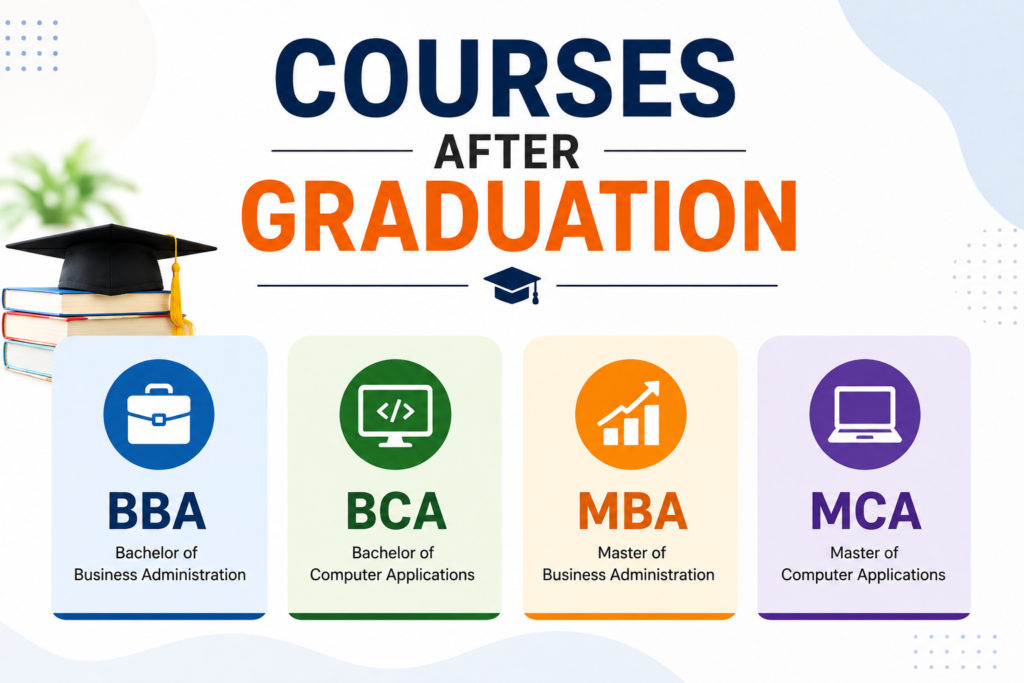
MBA is one of the most popular courses after graduation, particularly among students interested in management and business. An MBA can provide knowledge of areas such as finance, marketing, human resources, operations, business analytics, and entrepreneurship.
Students from different academic backgrounds may consider an MBA depending on the institution’s eligibility requirements. Specialising in a relevant area can help students develop management and decision-making skills for corporate and business environments.
2. Master of Commerce (M.Com)
For students with a background in commerce, accounting, or finance, M.Com can be a suitable postgraduate option. The programme generally provides advanced knowledge of commerce, accounting, taxation, economics, finance, and related subjects.
It can also serve as a foundation for students interested in teaching, research, finance, banking, or further academic studies.
3. Master of Arts (MA)
Students from humanities and social science backgrounds can consider an MA in subjects such as English, Economics, Sociology, Political Science, History, Psychology, or other disciplines.
A master’s degree can deepen subject knowledge and may support careers in education, research, public service, communication, social development, and related fields.
4. Master of Science (M.Sc.)
Graduates with a science background may consider an M.Sc. in their chosen subject or a related specialisation. These programmes generally focus on advanced theoretical and practical knowledge.
Depending on the subject, an M.Sc. can provide opportunities in research, education, laboratories, industry, technology, and specialised professional fields.
5. Master of Computer Applications (MCA)
For students interested in information technology and software development, MCA can be a valuable postgraduate option where they meet the applicable eligibility criteria.
The programme may cover areas such as programming, databases, software engineering, web technologies, networking, cloud computing, and emerging technologies. Career opportunities can include software development, IT services, application development, and related technology roles.
6. Professional and Skill-Based Courses
Not every student needs to pursue a traditional master’s degree. Short-term professional and skill-based programmes can also help graduates develop practical expertise.
Depending on their interests, students can explore areas such as:
- Digital marketing
- Data analytics
- Graphic design
- Web development
- Financial modelling
- Business analytics
- Content and communication
- Foreign languages
- Project management
- Cybersecurity
- Artificial intelligence
Before enrolling, students should evaluate the course content, practical training, certification value, and relevance to their intended career.
7. Law as a Career Option
Graduates interested in law can explore appropriate legal education pathways based on their existing qualification and applicable admission rules. A legal education can lead to opportunities in advocacy, corporate legal services, compliance, legal research, public service, and other areas.
Students should check the latest eligibility requirements and professional regulations before selecting a legal programme.
8. Teaching and Education Courses
Students interested in teaching can consider education-related programmes, subject to applicable eligibility requirements. Professional teacher education can provide knowledge of teaching methodologies, classroom management, educational psychology, assessment, and curriculum development.
Those interested in academic careers may also consider postgraduate education followed by research-oriented programmes.
9. Courses for Government and Competitive Exams
Some graduates prefer to prepare for competitive examinations rather than immediately pursuing another degree. Depending on eligibility and career goals, students may prepare for examinations related to civil services, banking, government recruitment, teaching, defence, railways, or other public-sector opportunities.
Coaching or preparation programmes can provide structured study plans, practice tests, current affairs preparation, and guidance. However, success ultimately depends on consistent preparation and understanding the official examination requirements.
10. Research and Higher Education
Students interested in academics and research can consider advanced postgraduate and research pathways. A master’s degree can often serve as a foundation for further specialised study, subject to the eligibility requirements of the relevant programme.
Research-oriented careers can be pursued in universities, laboratories, research institutions, industries, and other organisations.
How to Choose the Right Course After Graduation?
With so many options available, students should avoid choosing a course solely because friends or relatives recommend it. Instead, consider the following factors:
Identify Your Interests
Think about the subjects and activities you genuinely enjoy. A course is easier to pursue when it aligns with your interests and strengths.
Understand Career Opportunities
Research the types of roles associated with the course. Consider the current industry environment, required skills, growth opportunities, and long-term career potential.
Check Eligibility
Every programme has specific eligibility criteria. Always verify educational qualifications, entrance examinations, minimum marks, and other requirements before applying.
Consider Course Duration and Cost
Compare tuition fees, course duration, accommodation, transportation, and other expenses. Choose an option that is financially practical for you and your family.
Look at Institution Quality
The reputation of the institution is important, but students should also examine faculty, curriculum, infrastructure, practical training, placement support, industry exposure, and accreditation or recognition where applicable.
Focus on Skills
Employers increasingly value practical skills along with academic qualifications. Choose programmes that provide opportunities for projects, internships, practical assignments, workshops, and industry exposure.
Should You Work or Study After Graduation?
There is no universal answer. Some students may benefit from gaining work experience before pursuing higher education, while others may prefer to continue studying immediately.
Working first can help students understand their professional interests and gain practical experience. On the other hand, pursuing higher education immediately may be beneficial when a specific profession requires an advanced qualification.
The right decision depends on individual circumstances and career goals.
Build a Career with the Right Choice
Choosing among the many courses after graduation can feel overwhelming, but careful planning can make the process easier. Students should evaluate their interests, academic background, career objectives, finances, and future industry requirements before selecting a programme.
Institutions such as RBSMTC can be explored by students looking for further educational opportunities. Before admission, students should check the latest course offerings, eligibility criteria, curriculum, fees, facilities, and applicable recognition or affiliation.
Graduation should not be viewed as the end of education. It can be the beginning of a specialised and focused career journey. Whether you choose a master’s degree, professional programme, skill-based certification, competitive examination preparation, or another pathway, make sure your choice supports your long-term goals. With informed planning, continuous learning, and consistent effort, the right course after graduation can become a strong stepping stone toward a successful career.