

RBSMTC

logo 1
1 a

Raja Balwant Singh Management Technical Campus

Khandari Farm, Agra - 282002 (U.P.)

(Affiliated to Dr. A.P.J. Abdul Kalam Technical University, Lucknow & Approved by AICTE, New Delhi, MHRD, Govt. of India)

Khandari Farm, Agra - 282002 (U.P.)

(Affiliated to Dr. A.P.J. Abdul Kalam Technical University, Lucknow & Approved by AICTE, New Delhi, MHRD, Govt. of India)

"Empowering the Society through Quality Education" Merit List against Vacant Seats for the session 2026-27 | ADMISSION HELPLINES : MBA (9410662692) | MCA (9412315110) | MBA-Integrated (9058088437) | MCA-Integrated (9808093531) | E-mail : admissioncell.rbsmtc@gmail.com .

Uncategorized

MBA Admission in UP: Best Specializations and Career Opportunities

MBA Admission in UP: Best Specializations and Career Opportunities A Master of Business Administration (MBA) is a popular choice among graduates who want to build careers in management, business, finance, marketing, human resources, operations, and entrepreneurship. With organisations increasingly looking for professionals who can combine business knowledge with leadership, analytical thinking, and practical skills, an MBA can provide a strong foundation for long-term career development. For students planning MBA Admission in UP, selecting the right specialisation and institution is an important decision. Uttar Pradesh has a large higher-education ecosystem, giving students opportunities to explore management education in different cities and institutions. This guide explains popular MBA specialisations, admission considerations, career opportunities, and factors students should evaluate before choosing an MBA programme. Why Choose an MBA? An MBA provides students with a broader understanding of business and management. Unlike undergraduate programmes that introduce students to basic business concepts, an MBA focuses more deeply on strategic decision-making, leadership, organisational management, and specialised business functions. Students may pursue an MBA to: However, an MBA should be selected according to individual career goals rather than simply following a popular trend. Popular MBA Specializations Choosing the right specialisation is one of the most important decisions during MBA admission. Students should consider their interests, strengths, educational background, and long-term career plans. 1. MBA in Marketing Marketing is one of the most popular MBA specialisations. It focuses on understanding customers, markets, brands, sales, advertising, and business growth. Students may study areas such as: Marketing can be suitable for students who enjoy communication, creativity, market analysis, and working with customers. Career opportunities may include marketing executive, brand executive, sales manager, business development professional, digital marketing specialist, or marketing manager, depending on qualifications and experience. 2. MBA in Finance Finance is suitable for students who are interested in numbers, financial planning, investment, accounting, and business decision-making. An MBA in Finance may cover: Graduates can explore opportunities in banking, financial services, corporate finance, investment-related roles, financial analysis, and other business functions. 3. MBA in Human Resource Management Human resources focuses on managing an organisation’s workforce. HR professionals are responsible for activities such as recruitment, training, employee engagement, performance management, and organisational development. Students may learn about: HR can be a suitable choice for students who enjoy communication, teamwork, conflict resolution, and people management. 4. MBA in Operations Management Operations management focuses on improving business processes and ensuring that resources are used efficiently. Students may study: This specialisation can be useful for students interested in manufacturing, logistics, retail, e-commerce, supply chains, and service operations. 5. MBA in Business Analytics Data has become an important part of modern business decision-making. Business Analytics combines management knowledge with data analysis to help organisations understand trends and make informed decisions. Students may develop knowledge in areas such as: Career opportunities may include business analyst, data-oriented management roles, consulting, market analysis, and business intelligence functions. 6. MBA in Entrepreneurship Entrepreneurship is designed for students who are interested in creating and managing businesses. It can help students understand how to identify opportunities, evaluate markets, develop business plans, and manage resources. Students may study: This specialisation can be particularly useful for aspiring entrepreneurs and students interested in family businesses. 7. MBA in International Business International Business focuses on managing organisations and business activities across national borders. Students may learn about: This specialisation can be suitable for students interested in multinational companies and global business environments. MBA Admission in UP: What Students Should Know The admission process can vary depending on the institution, programme, and applicable admission rules. Students should always check the latest requirements of the specific college or university before applying. Common admission considerations may include: Educational Qualification Applicants generally need a recognised bachelor’s degree, subject to the eligibility requirements of the institution and programme. Entrance Examination Some institutions admit students through management entrance examinations, while others may have different admission processes. Students should check the specific requirements of the institution they are applying to. Application Form Candidates generally need to complete an application form and provide academic and other required information within the specified deadline. Selection Process Depending on the institution, selection may involve entrance-test performance, academic record, interviews, group discussions, or other assessment methods. Students should verify all current eligibility criteria, deadlines, fees, and admission procedures directly with the institution before applying. How to Choose the Right MBA Specialization Choosing a specialisation should be based on more than salary expectations. Students should evaluate their interests and strengths. Ask yourself: For example, a student who enjoys numbers may prefer finance, while someone interested in consumer behaviour may choose marketing. A student who enjoys working with people may find HR suitable, whereas someone interested in data may explore business analytics. Career Opportunities After an MBA An MBA can provide access to career opportunities across multiple sectors. Depending on specialisation, skills, experience, and employer requirements, graduates may explore roles such as: MBA graduates can work in industries including banking, finance, information technology, healthcare, manufacturing, retail, logistics, consulting, education, consumer goods, and e-commerce. Importance of Industry Exposure Management education becomes more valuable when students can apply classroom concepts to practical business situations. When comparing institutions for MBA Admission in UP, students should look for opportunities such as: These experiences can help students understand workplace expectations and develop professional confidence. Role of Internships in MBA Education Internships provide students with an opportunity to gain real-world exposure before completing their degree. They can help students understand organisational culture and apply classroom knowledge. An internship can also help students discover their strengths and identify which business functions interest them most. Students should therefore consider the availability of internship opportunities and career-development support when selecting an MBA college. Skills MBA Students Should Develop An MBA qualification alone does not guarantee professional success. Students should develop practical skills alongside their academic education. Important skills include: Communication Clear communication is essential for presentations, meetings, negotiations, and leadership. Leadership Managers need to motivate teams, delegate responsibilities, and take accountability for decisions. Analytical Thinking Analytical skills

MBA Admission in UP: Best Specializations and Career Opportunities Read More »

MBA College IN UP

How an MBA College in UP Can Help You Build a Successful Career

An MBA is one of the most popular postgraduate qualifications for students who want to build careers in management, business, finance, marketing, human resources, operations, entrepreneurship, and related fields. As businesses become increasingly competitive and technology continues to transform workplaces, employers are looking for professionals who can combine business knowledge with leadership, analytical thinking, communication, and problem-solving skills. Choosing the right MBA College in UP can play an important role in developing these capabilities. A quality management institution can provide students with academic knowledge, practical exposure, professional networks, internships, and career guidance that prepare them for the challenges of the modern business world. Why Pursue an MBA? An MBA helps students develop a broader understanding of how organisations operate and make strategic decisions. While undergraduate programmes provide foundational knowledge, an MBA allows students to explore management concepts in greater depth and develop specialised expertise. Students may pursue an MBA to: However, the value of an MBA depends greatly on the quality of education and practical opportunities provided by the institution. How an MBA College in UP Can Support Career Growth 1. Provides a Strong Foundation in Business Management A good MBA programme introduces students to essential areas of management and business. Depending on the curriculum and specialisation, students may study marketing, finance, human resources, operations, economics, business analytics, organisational behaviour, entrepreneurship, and strategic management. This broad knowledge helps students understand how different departments within an organisation work together. For example, a marketing decision can influence sales, while financial planning can affect business expansion. Understanding these connections helps students develop a more comprehensive approach to management. 2. Offers Specialisation Opportunities One of the major advantages of pursuing an MBA is the opportunity to specialise in a particular field. Students may explore areas such as: Marketing: Suitable for students interested in branding, consumer behaviour, advertising, sales, and digital marketing. Finance: Focuses on financial planning, investments, accounting, corporate finance, and financial analysis. Human Resources: Covers recruitment, employee relations, training, performance management, and organisational development. Operations: Deals with business processes, logistics, supply chain management, production, and resource utilisation. Business Analytics: Combines business knowledge with data analysis to support better organisational decisions. Entrepreneurship: Helps students understand business planning, innovation, market research, and venture development. Selecting a specialisation that matches your interests and career goals can help create a more focused professional path. 3. Develops Leadership Skills Successful managers need more than technical knowledge. They must be able to lead teams, communicate effectively, manage conflicts, delegate responsibilities, and make informed decisions. An MBA college can develop leadership abilities through group projects, presentations, discussions, management activities, student clubs, case studies, and other collaborative exercises. These experiences can help students become more comfortable taking responsibility and working with people from different backgrounds. 4. Encourages Practical Learning Management education becomes more meaningful when students can apply classroom concepts to real-world situations. Case studies, business simulations, projects, presentations, industry assignments, and practical exercises can help students understand how management theories work in actual business environments. For example, instead of simply studying marketing principles, students may analyse a company’s marketing strategy and identify opportunities for improvement. Practical learning encourages students to think critically and develop solutions rather than simply memorising concepts. 5. Provides Industry Exposure Interaction with industry professionals can help students understand current business trends and workplace expectations. An MBA College in UP may provide industry exposure through: Such activities can help students connect academic concepts with professional practices. 6. Creates Internship Opportunities Internships are an important part of professional development. They allow students to gain experience in an actual workplace and understand organisational culture. During an internship, students may work in areas such as marketing, sales, finance, human resources, operations, research, or business development. Internships can help students: Students should therefore consider an institution’s internship support when comparing MBA programmes. 7. Supports Career and Placement Preparation Starting a career after completing an MBA can be challenging without proper preparation. Career development programmes can help students become more confident during the recruitment process. A college may support students through: Students should remember that placements depend on several factors, including individual skills, academic performance, experience, market conditions, and employer requirements. Nevertheless, institutional career support can provide valuable guidance. 8. Builds Professional Networks Networking is an important part of modern business. An MBA programme brings students into contact with classmates, faculty members, industry professionals, alumni, and business leaders. These connections can provide opportunities to exchange ideas, learn about different industries, discover career opportunities, and develop professional relationships. Networking can also be useful for students interested in entrepreneurship because successful businesses often depend on strong professional and industry connections. 9. Develops Communication and Soft Skills Employers value candidates who can communicate ideas clearly and work effectively with teams. MBA programmes can help students develop: These skills are transferable across industries and can support career growth even when professionals change roles or sectors. 10. Encourages Entrepreneurship Not every MBA graduate wants to work for a large corporation. Some students may want to establish their own businesses. Management education can help aspiring entrepreneurs understand important areas such as market research, financial planning, business strategy, customer analysis, marketing, operations, and human resources. Colleges that organise entrepreneurship workshops, business-plan competitions, innovation activities, or startup programmes can provide additional exposure to the entrepreneurial process. Career Opportunities After an MBA An MBA can prepare graduates for a wide range of professional roles. Depending on their specialisation, qualifications, skills, and experience, graduates may explore careers such as: MBA graduates can find opportunities in sectors such as banking, finance, technology, healthcare, retail, manufacturing, education, logistics, consulting, and consumer goods. Why Choose an MBA College in Uttar Pradesh? Uttar Pradesh has a large higher-education ecosystem and offers students access to institutions across various academic and professional disciplines. For students who want to study management within the state, an MBA College in UP can offer the convenience of studying closer to home while providing opportunities to interact with students and businesses from different regions. However, students should not select a college only

How an MBA College in UP Can Help You Build a Successful Career Read More »

Courses After Graduation

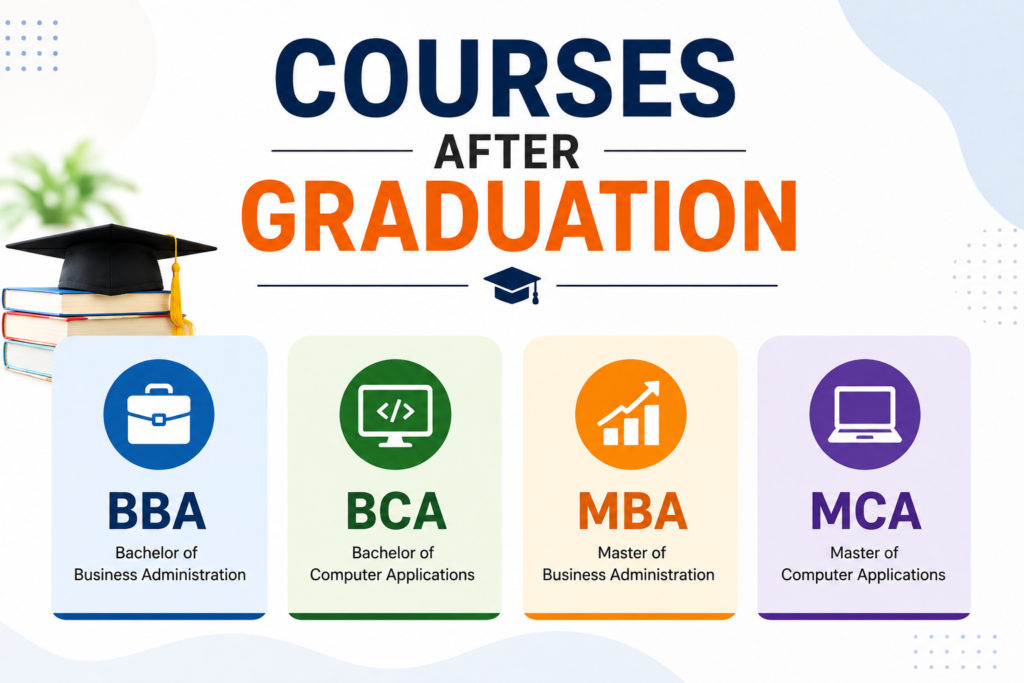
Courses After Graduation: A Complete Career Guide for Students

Graduation is an important milestone, but for many students, it is only the beginning of their professional journey. After completing a bachelor’s degree, students often face an important question: What should I do after graduation? The answer depends on individual interests, career goals, academic background, financial considerations, and long-term plans. From postgraduate degrees and professional programmes to skill-based certifications and competitive exam preparation, there are numerous courses after graduation that can help students build a successful career. Understanding the available options can make this decision easier and more informed. Why Choose a Course After Graduation? A graduate degree provides foundational knowledge, but additional education can help students specialise in a particular field. Pursuing a postgraduate or professional course can also help develop advanced skills and improve career readiness. Students may choose further education to: The ideal course should match a student’s interests, abilities, and career objectives rather than being selected simply because it is popular. 1. Master of Business Administration (MBA) MBA is one of the most popular courses after graduation, particularly among students interested in management and business. An MBA can provide knowledge of areas such as finance, marketing, human resources, operations, business analytics, and entrepreneurship. Students from different academic backgrounds may consider an MBA depending on the institution’s eligibility requirements. Specialising in a relevant area can help students develop management and decision-making skills for corporate and business environments. 2. Master of Commerce (M.Com) For students with a background in commerce, accounting, or finance, M.Com can be a suitable postgraduate option. The programme generally provides advanced knowledge of commerce, accounting, taxation, economics, finance, and related subjects. It can also serve as a foundation for students interested in teaching, research, finance, banking, or further academic studies. 3. Master of Arts (MA) Students from humanities and social science backgrounds can consider an MA in subjects such as English, Economics, Sociology, Political Science, History, Psychology, or other disciplines. A master’s degree can deepen subject knowledge and may support careers in education, research, public service, communication, social development, and related fields. 4. Master of Science (M.Sc.) Graduates with a science background may consider an M.Sc. in their chosen subject or a related specialisation. These programmes generally focus on advanced theoretical and practical knowledge. Depending on the subject, an M.Sc. can provide opportunities in research, education, laboratories, industry, technology, and specialised professional fields. 5. Master of Computer Applications (MCA) For students interested in information technology and software development, MCA can be a valuable postgraduate option where they meet the applicable eligibility criteria. The programme may cover areas such as programming, databases, software engineering, web technologies, networking, cloud computing, and emerging technologies. Career opportunities can include software development, IT services, application development, and related technology roles. 6. Professional and Skill-Based Courses Not every student needs to pursue a traditional master’s degree. Short-term professional and skill-based programmes can also help graduates develop practical expertise. Depending on their interests, students can explore areas such as: Before enrolling, students should evaluate the course content, practical training, certification value, and relevance to their intended career. 7. Law as a Career Option Graduates interested in law can explore appropriate legal education pathways based on their existing qualification and applicable admission rules. A legal education can lead to opportunities in advocacy, corporate legal services, compliance, legal research, public service, and other areas. Students should check the latest eligibility requirements and professional regulations before selecting a legal programme. 8. Teaching and Education Courses Students interested in teaching can consider education-related programmes, subject to applicable eligibility requirements. Professional teacher education can provide knowledge of teaching methodologies, classroom management, educational psychology, assessment, and curriculum development. Those interested in academic careers may also consider postgraduate education followed by research-oriented programmes. 9. Courses for Government and Competitive Exams Some graduates prefer to prepare for competitive examinations rather than immediately pursuing another degree. Depending on eligibility and career goals, students may prepare for examinations related to civil services, banking, government recruitment, teaching, defence, railways, or other public-sector opportunities. Coaching or preparation programmes can provide structured study plans, practice tests, current affairs preparation, and guidance. However, success ultimately depends on consistent preparation and understanding the official examination requirements. 10. Research and Higher Education Students interested in academics and research can consider advanced postgraduate and research pathways. A master’s degree can often serve as a foundation for further specialised study, subject to the eligibility requirements of the relevant programme. Research-oriented careers can be pursued in universities, laboratories, research institutions, industries, and other organisations. How to Choose the Right Course After Graduation? With so many options available, students should avoid choosing a course solely because friends or relatives recommend it. Instead, consider the following factors: Identify Your Interests Think about the subjects and activities you genuinely enjoy. A course is easier to pursue when it aligns with your interests and strengths. Understand Career Opportunities Research the types of roles associated with the course. Consider the current industry environment, required skills, growth opportunities, and long-term career potential. Check Eligibility Every programme has specific eligibility criteria. Always verify educational qualifications, entrance examinations, minimum marks, and other requirements before applying. Consider Course Duration and Cost Compare tuition fees, course duration, accommodation, transportation, and other expenses. Choose an option that is financially practical for you and your family. Look at Institution Quality The reputation of the institution is important, but students should also examine faculty, curriculum, infrastructure, practical training, placement support, industry exposure, and accreditation or recognition where applicable. Focus on Skills Employers increasingly value practical skills along with academic qualifications. Choose programmes that provide opportunities for projects, internships, practical assignments, workshops, and industry exposure. Should You Work or Study After Graduation? There is no universal answer. Some students may benefit from gaining work experience before pursuing higher education, while others may prefer to continue studying immediately. Working first can help students understand their professional interests and gain practical experience. On the other hand, pursuing higher education immediately may be beneficial when a specific profession requires an advanced qualification. The right decision depends

Courses After Graduation: A Complete Career Guide for Students Read More »

Best MBA Specializations for Future Jobs

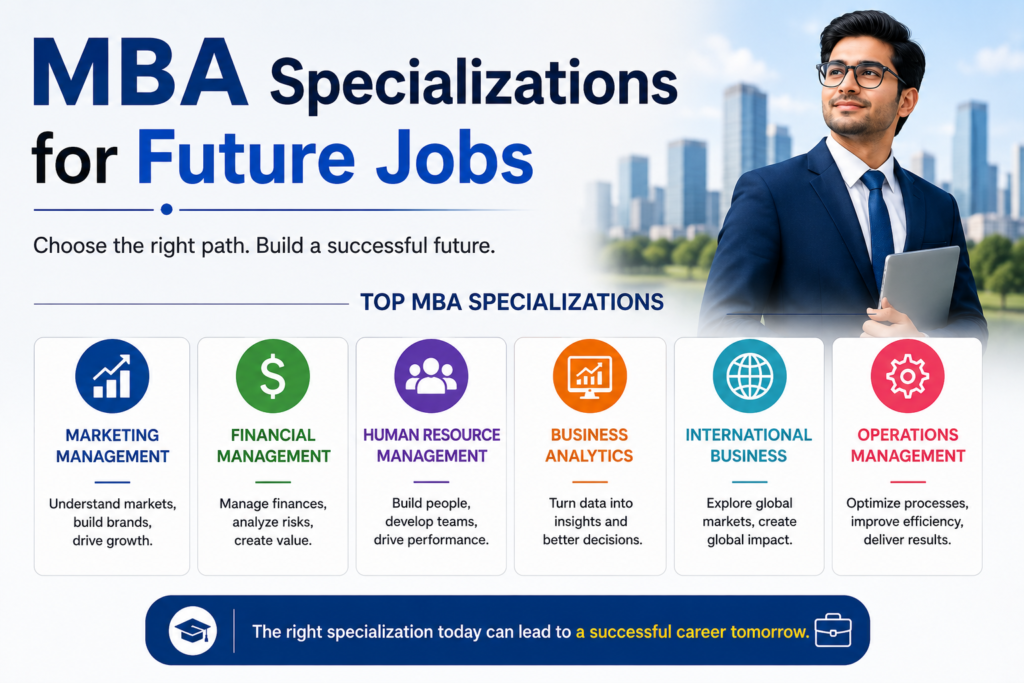
Pursuing an MBA has become one of the most popular career choices for students and working professionals who want to build strong leadership skills and secure high-paying jobs. However, selecting the right MBA specialization is equally important because it determines your career direction, job opportunities, and long-term growth. With industries rapidly evolving due to technology, globalization, and changing consumer demands, certain MBA specializations are becoming more valuable for future jobs. Students today must choose a specialization that aligns with market trends, personal interests, and future career goals. For students considering an MBA at RBSMTC, understanding the best MBA specializations can help them make informed career decisions and prepare for future industry demands. Why Choosing the Right MBA Specialization Matters An MBA program provides a broad understanding of business management, but specialization helps students develop expertise in a particular field. Employers often look for candidates with specialized knowledge and practical skills relevant to their industry. Choosing the right specialization can help students: The right specialization also helps students stay relevant in future job markets shaped by innovation and digital transformation. MBA in Marketing Marketing remains one of the most popular and future-focused MBA specializations. Businesses constantly need professionals who can understand customer behavior, promote products, and drive sales growth. Career Opportunities in Marketing Students pursuing an MBA in Marketing can work as: Why Marketing Has a Strong Future With the rapid growth of digital platforms, social media, e-commerce, and online advertising, marketing professionals are in high demand. Companies need creative and data-driven marketers to stay competitive in modern markets. Students interested in communication, creativity, and strategy often find marketing an exciting career path after MBA. MBA in Finance Finance is one of the most respected and rewarding MBA specializations. It focuses on financial planning, investment management, banking, risk analysis, and corporate finance. Career Opportunities in Finance Graduates can pursue roles such as: Future Scope of Finance The finance sector continues to grow due to increasing global investments, fintech innovations, and corporate financial planning needs. Professionals with financial expertise are essential across industries. Students with strong analytical and numerical skills often choose finance for stable and high-paying career opportunities. MBA in Human Resource Management (HR) Human Resource Management focuses on managing employees, organizational culture, recruitment, training, and workforce development. Career Opportunities in HR HR graduates can work as: Why HR is Important for Future Jobs As companies prioritize employee well-being, diversity, and workplace culture, skilled HR professionals are becoming increasingly important. Modern HR also involves data analytics and strategic workforce planning. Students with strong interpersonal and communication skills may find HR management highly rewarding. MBA in Business Analytics Business Analytics is one of the fastest-growing MBA specializations today. It combines business management with data analysis to support better decision-making. Career Opportunities in Business Analytics Graduates can work as: Future Scope of Business Analytics Companies today rely heavily on data to improve performance, understand customers, and predict trends. The demand for professionals who can analyze data and generate business insights is rapidly increasing. Students interested in technology, statistics, and strategic thinking often choose this future-oriented specialization. MBA in Information Technology (IT) MBA in Information Technology combines management skills with technical knowledge. This specialization is ideal for students interested in technology-driven business environments. Career Opportunities in IT Management Students can work as: Why IT Management Has Strong Demand Digital transformation is reshaping industries globally. Businesses require professionals who can manage technology systems while understanding business objectives. The growing use of cloud computing, cybersecurity, artificial intelligence, and software solutions makes IT management a promising field for future careers. MBA in Operations Management Operations Management focuses on improving business efficiency, supply chain management, logistics, and production processes. Career Opportunities in Operations Graduates can pursue roles such as: Future Scope of Operations Management The growth of manufacturing, e-commerce, and global supply chains has increased the demand for operations professionals who can optimize productivity and reduce costs. Students with organizational and problem-solving skills often excel in this field. MBA in International Business International Business is an excellent specialization for students interested in global trade and multinational companies. Career Opportunities in International Business Students can work as: Why International Business is Growing Globalization has created opportunities for businesses to expand internationally. Companies need professionals who understand international markets, trade regulations, and cross-cultural communication. This specialization is ideal for students interested in global business environments. MBA in Healthcare Management Healthcare Management is becoming increasingly important as the healthcare industry continues to expand. Career Opportunities in Healthcare Management Graduates can work as: Future Scope of Healthcare Management The growing healthcare sector requires skilled managers to handle hospital operations, healthcare services, and patient management systems. Students interested in healthcare administration and management can find excellent opportunities in this field. MBA in Digital Marketing Digital Marketing has emerged as one of the most in-demand MBA specializations due to the rise of online businesses and internet users. Career Opportunities in Digital Marketing Students can become: Why Digital Marketing is the Future Businesses today heavily rely on online marketing to attract customers and build brand awareness. Digital marketing professionals are needed across industries and startups. This specialization is ideal for students who enjoy creativity, analytics, and online communication. How to Choose the Best MBA Specialization Selecting the right MBA specialization requires careful planning. Students should consider: Personal Interests Choose a field you genuinely enjoy and feel motivated to work in. Market Demand Research industries with strong future growth and job opportunities. Skill Set Evaluate your strengths, such as analytical ability, communication, creativity, or leadership. Career Goals Think about your long-term professional aspirations and preferred work environment. Industry Trends Stay updated with evolving technologies and business needs. Career After MBA An MBA degree opens the door to numerous career opportunities across industries. The right specialization can help students secure leadership positions, higher salaries, and long-term professional success. A successful career after MBA depends on: Management education helps students become confident decision-makers capable of handling modern business challenges. Conclusion Choosing the best MBA specialization is a

Best MBA Specializations for Future Jobs Read More »

MBA at RBSMTC

MBA vs PGDM: Which is Better for Your Career?

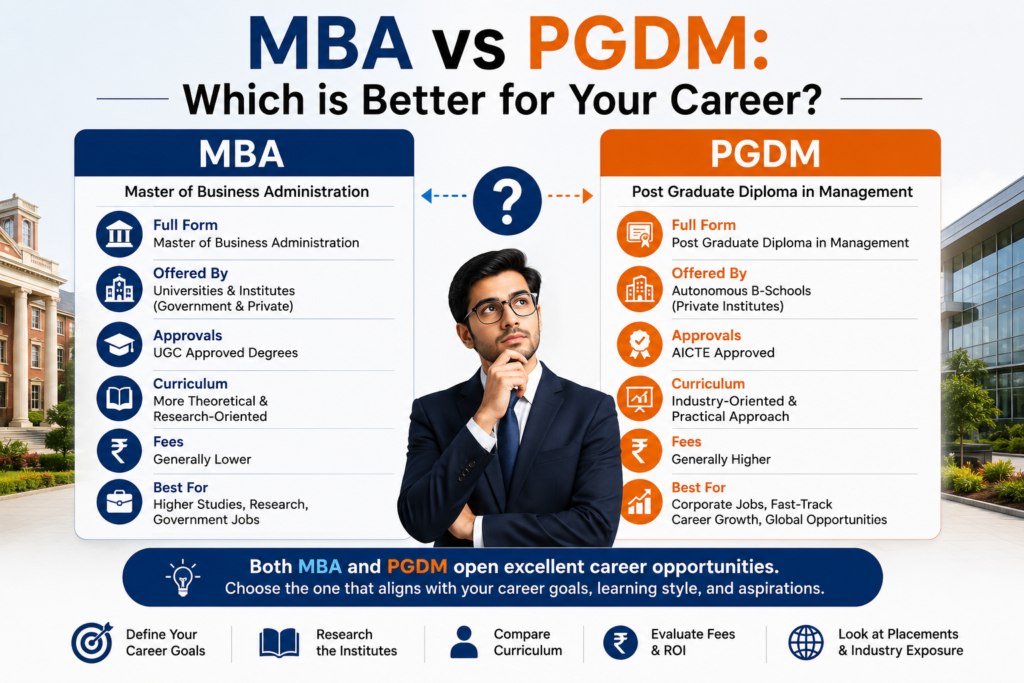
Best MBA College in Agra Choosing the right postgraduate management program is one of the most important decisions for students aspiring to build a successful career in business and management. Among the most popular options in India are MBA (Master of Business Administration) and PGDM (Post Graduate Diploma in Management). While both programs focus on management education and career growth, they differ in structure, curriculum, recognition, and industry orientation. Many students often get confused when deciding between an MBA and a PGDM course. Understanding the differences, advantages, and career opportunities associated with both programs can help students make an informed decision based on their career goals. For students searching for the Best MBA College in Agra, institutions like RBSMTC provide quality management education designed to prepare students for modern business challenges. Understanding MBA MBA stands for Master of Business Administration. It is a degree program offered by universities and colleges affiliated with recognized universities. MBA programs are regulated by the University Grants Commission (UGC) and focus on providing theoretical and academic knowledge of management. The course generally covers subjects such as: MBA programs are widely recognized in India and abroad and are ideal for students looking for a strong academic foundation in management studies. Understanding PGDM PGDM stands for Post Graduate Diploma in Management. It is a diploma program offered mainly by autonomous institutions approved by AICTE (All India Council for Technical Education). Unlike MBA programs, PGDM institutes have greater flexibility in designing their curriculum. This allows them to update course content regularly according to industry trends and market demands. PGDM programs focus heavily on: Students seeking a more industry-oriented learning experience often prefer PGDM courses. MBA vs PGDM: Key Differences Although MBA and PGDM may appear similar, there are several important differences between them. Degree vs Diploma An MBA is a university-recognized degree program, whereas PGDM is a diploma program offered by autonomous institutes. Curriculum Structure MBA programs generally follow a fixed university syllabus that changes less frequently. PGDM programs are more flexible and frequently updated according to industry requirements. Focus Area MBA focuses more on theoretical and conceptual understanding, while PGDM emphasizes practical knowledge and real-world business applications. Industry Exposure PGDM courses often include workshops, internships, live projects, and industry interactions to enhance practical skills. Affiliation MBA colleges are affiliated with universities, while PGDM institutes operate autonomously under AICTE approval. Which Course Has Better Career Opportunities? Both MBA and PGDM programs offer excellent career opportunities. The value of the course depends more on the reputation of the institution, faculty quality, curriculum, and placement opportunities rather than just the course title. Graduates from both MBA and PGDM programs can work in areas such as: Top recruiters hire candidates from both MBA and PGDM institutions based on their skills, knowledge, and practical abilities. Advantages of MBA An MBA program offers several benefits for students aiming for stable career growth. Strong Academic Recognition MBA degrees are widely accepted for government jobs, higher education, and international opportunities. Affordable Fee Structure MBA programs offered by universities are often more affordable compared to PGDM courses at private institutions. Suitable for Academic Careers Students interested in teaching, research, or pursuing doctoral studies may prefer an MBA degree. Standardized Curriculum MBA courses provide a strong theoretical foundation in management principles. Advantages of PGDM PGDM programs are highly preferred by students who want industry-focused learning and corporate exposure. Updated Curriculum PGDM institutes regularly revise their syllabus according to changing business trends. Industry-Oriented Learning The course focuses on practical management skills and real-world business situations. Better Skill Development Students develop communication, leadership, analytical, and decision-making skills through workshops and projects. Corporate Exposure Many PGDM institutes collaborate with industries for internships, seminars, and placement opportunities. Factors to Consider Before Choosing MBA or PGDM Students should carefully evaluate several factors before making a decision. Career Goals If your goal is academic research or government sector jobs, MBA may be more suitable. If you prefer corporate exposure and practical learning, PGDM can be a better choice. Institution Reputation The reputation and accreditation of the institute matter more than the course title itself. Placement Opportunities Check the placement record, recruiter network, and average salary packages offered by the institution. Curriculum and Specialization Choose a program that offers specializations aligned with your career interests. Fee Structure Compare tuition fees and return on investment before enrolling. Popular Specializations in MBA and PGDM Both MBA and PGDM programs offer various specializations based on industry demand. Popular specializations include: Choosing the right specialization can significantly impact career growth and opportunities. Importance of Choosing the Right Management College The quality of education and exposure students receive depends greatly on the institution they choose. A reputed college provides: Students searching for the Best MBA College in Agra often look for institutions that combine academic excellence with practical training and career support. Why Management Education Matters Today In today’s competitive business environment, management education helps students develop leadership, strategic thinking, and problem-solving abilities. Companies seek professionals who can handle challenges, manage teams, and contribute to organizational growth. An MBA or PGDM program equips students with: These skills are essential for long-term career success across industries. Conclusion The debate around MBA vs PGDM ultimately depends on individual career goals, learning preferences, and the institution chosen. Both programs offer excellent career opportunities and can lead to successful professional growth when pursued from a reputed institute. Students who prefer academic depth and university recognition may choose an MBA, while those looking for practical exposure and industry-oriented learning may find PGDM more suitable. The key is to select a trusted institution that focuses on quality education, skill development, and career advancement. For students aspiring to pursue management education from the Best MBA College in Agra, RBSMTC provides a strong platform for academic excellence, professional development, and future career success.

MBA vs PGDM: Which is Better for Your Career? Read More »