

RBSMTC

logo 1
1 a

Raja Balwant Singh Management Technical Campus

Khandari Farm, Agra - 282002 (U.P.)

(Affiliated to Dr. A.P.J. Abdul Kalam Technical University, Lucknow & Approved by AICTE, New Delhi, MHRD, Govt. of India)

Khandari Farm, Agra - 282002 (U.P.)

(Affiliated to Dr. A.P.J. Abdul Kalam Technical University, Lucknow & Approved by AICTE, New Delhi, MHRD, Govt. of India)

"Empowering the Society through Quality Education" Merit List against Vacant Seats for the session 2026-27 | ADMISSION HELPLINES : MBA (9219171874) | MCA (9412315110) | MBA-Integrated (9058088437) | MCA-Integrated (9808093531) | E-mail : admissioncell.rbsmtc@gmail.com .

admin

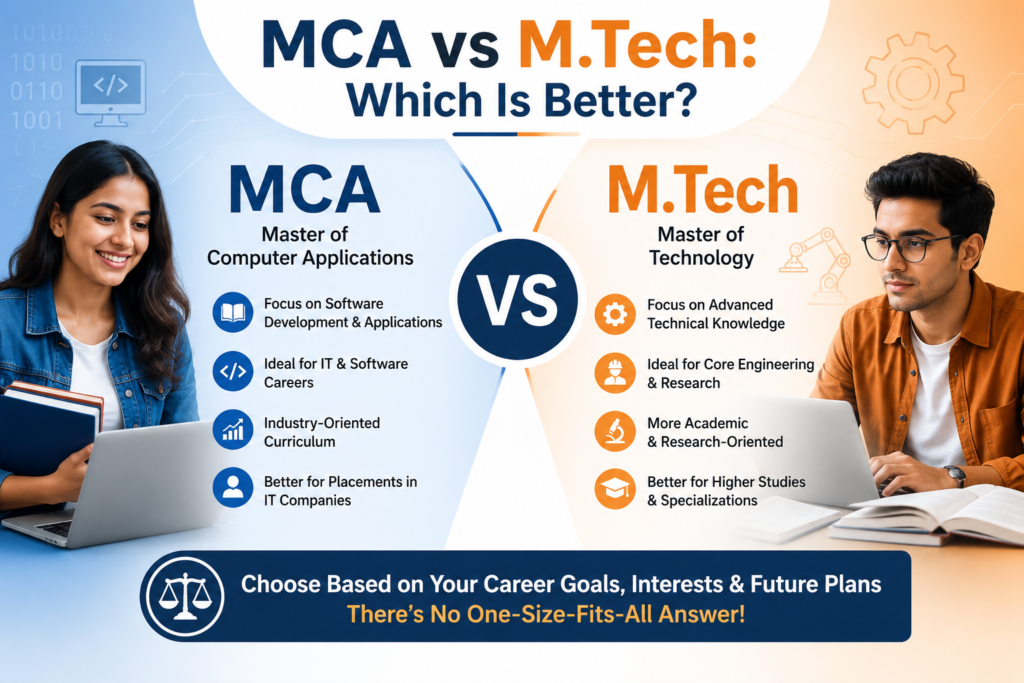
MCA vs M.Tech: Which Is Better for a Career in IT?

MCA vs M.Tech: Which Is Better for a Career in IT

The Information Technology (IT) industry continues to be one of the fastest-growing sectors globally, offering diverse career opportunities in software development, data science, cybersecurity, artificial intelligence, cloud computing, and more. As technology evolves, students often seek advanced education to enhance their skills, improve career prospects, and gain a competitive edge in the job market. Among the most popular postgraduate options for IT aspirants are the Master of Computer Applications (MCA) and Master of Technology (M.Tech). Both programs offer excellent opportunities, but they are designed for different career goals and educational backgrounds. As a result, many students find themselves asking: MCA vs M.Tech – which is better for a career in IT? The answer depends on your academic background, career aspirations, interests, and long-term professional goals. Understanding the differences between these programs can help you make an informed decision. Understanding MCA and M.Tech Before comparing the two programs, it is important to understand what each degree offers. What Is MCA? Master of Computer Applications (MCA) is a postgraduate degree focused on computer applications, software development, programming, and information technology. The program is designed to provide students with practical and theoretical knowledge in areas such as: MCA is particularly suitable for students who wish to build careers in software and IT-related industries. What Is M.Tech? Master of Technology (M.Tech) is a postgraduate engineering degree that focuses on advanced technical concepts, research, and specialization. Students can pursue M.Tech in various disciplines, including: M.Tech programs generally emphasize technical depth, research, innovation, and advanced engineering concepts. Eligibility Criteria: MCA vs M.Tech MCA Eligibility Students can typically pursue MCA after completing a bachelor’s degree with mathematics as a subject at the 10+2 or graduation level, depending on university requirements. Common undergraduate backgrounds include: M.Tech Eligibility M.Tech usually requires a technical undergraduate degree such as: Many institutions also consider GATE scores during the admission process. This makes MCA more accessible for students from diverse academic backgrounds. Curriculum Comparison MCA Curriculum The MCA curriculum focuses on industry-oriented skills and practical applications. Key subjects often include: Students gain extensive hands-on experience through projects, internships, and practical assignments. M.Tech Curriculum M.Tech programs focus more on technical specialization and advanced engineering concepts. Common areas include: The curriculum often includes research projects and technical dissertations. Career Opportunities After MCA An MCA degree opens doors to a wide range of IT careers. Popular job roles include: Software Developer Developing applications, software solutions, and digital platforms for businesses and consumers. Web Developer Creating and maintaining websites and web applications. Mobile App Developer Designing applications for Android and iOS platforms. Data Analyst Analyzing data to support business decisions and improve performance. System Analyst Evaluating and improving IT systems within organizations. Cloud Computing Specialist Managing cloud infrastructure and deployment solutions. The MCA degree is highly valued by IT companies seeking professionals with strong software development and programming skills. Career Opportunities After M.Tech M.Tech graduates often pursue specialized technical and research-oriented roles. Career options include: Research Scientist Working on technological innovation and advanced computing solutions. Software Architect Designing large-scale software systems and frameworks. Technical Consultant Providing specialized expertise to organizations. AI and Machine Learning Engineer Developing advanced AI-based solutions and intelligent systems. Academic and Research Careers Many M.Tech graduates choose teaching or doctoral research pathways. MCA vs M.Tech: Which Offers Better Job Opportunities? Both degrees provide excellent employment opportunities, but the nature of the roles often differs. MCA Advantages M.Tech Advantages For students aiming to enter software development, application development, IT consulting, and corporate technology roles, MCA often provides a direct and practical career pathway. MCA vs M.Tech: Salary Comparison Salary depends on several factors, including: Both MCA and M.Tech graduates can secure competitive salary packages. Professionals with expertise in: are particularly sought after in today’s technology-driven market. Ultimately, individual skills and practical experience often have a greater impact on salary than the degree title alone. Which Degree Is Better for the Future? The future of IT is driven by innovation, digital transformation, automation, and emerging technologies. MCA graduates are well-positioned for careers involving: M.Tech graduates are often better suited for: Students should choose a program based on their interests rather than solely on perceived career advantages. Factors to Consider Before Choosing Before deciding between MCA and M.Tech, ask yourself: What Is Your Educational Background? Engineering graduates may naturally align with M.Tech, while students from computer applications and related fields often prefer MCA. What Are Your Career Goals? If you want to work in software development and IT services, MCA may be ideal. If you are interested in advanced research and technical specialization, M.Tech could be a better fit. Do You Prefer Practical Learning or Research? MCA focuses heavily on practical applications, whereas M.Tech often emphasizes technical depth and research. What Industry Role Do You Envision? Your desired job role should influence your academic choice. Choosing the Right Institution Matters Whether you choose MCA or M.Tech, the quality of education plays a crucial role in career success. Students should look for institutions that offer: Many students searching for the Best MCA College In India, Best MCA College In Agra, or among the Best MCA Colleges prioritize institutions that combine academic excellence with practical industry exposure to prepare graduates for evolving IT careers. Conclusion Both MCA and M.Tech are valuable postgraduate programs that can lead to successful careers in the IT industry. The right choice depends on your academic background, professional aspirations, and preferred career path. MCA is often ideal for students seeking practical software development and IT careers, while M.Tech is better suited for those interested in advanced technical specialization and research. With a strong curriculum, experienced faculty, and industry-focused learning environment, RBSMTC helps students develop the technical expertise, problem-solving abilities, and professional skills needed to succeed in today’s rapidly evolving technology landscape.

MCA vs M.Tech: Which Is Better for a Career in IT Read More »

Best MBA College In India

How an MBA Degree Can Help You Achieve Leadership Success

In today’s highly competitive business environment, organizations are constantly seeking professionals who can lead teams, make strategic decisions, and drive growth. Leadership is no longer limited to senior executives; companies expect managers at every level to demonstrate leadership qualities that contribute to organizational success. This is one of the reasons why an MBA (Master of Business Administration) continues to be one of the most sought-after postgraduate degrees worldwide. Students who choose the Best MBA College In India gain access to quality education, industry exposure, and practical learning opportunities that help them develop strong managerial and leadership capabilities. An MBA is more than just a management qualification. It is a transformative educational experience that equips students with the knowledge, skills, and confidence needed to become effective leaders in their chosen industries. Whether you aspire to manage a business, lead a team, launch a startup, or advance into executive positions, an MBA can play a crucial role in helping you achieve your goals. . Understanding the Value of an MBA Degree An MBA program is designed to provide a comprehensive understanding of various aspects of business and management. Students gain exposure to key areas such as: This broad knowledge base enables graduates to understand how different business functions work together and how effective leadership can influence organizational performance. Leadership: A Critical Skill in Modern Business Leadership is the ability to inspire, motivate, and guide individuals toward achieving common objectives. Successful leaders are not only responsible for making decisions but also for building strong teams, managing challenges, and creating a positive work culture. Modern organizations value leaders who can: MBA programs are specifically designed to develop these capabilities through classroom learning, case studies, group projects, internships, and practical business exposure. How an MBA Develops Leadership Skills Enhances Strategic Thinking One of the primary qualities of successful leaders is the ability to think beyond day-to-day operations and focus on long-term objectives. MBA students learn how to: These skills help future leaders contribute to organizational growth and sustainability. Improves Decision-Making Abilities Leaders often face situations that require quick and effective decision-making. During an MBA program, students are exposed to real-world business scenarios through: These experiences help students develop analytical thinking and decision-making skills that are essential for leadership roles. Strengthens Communication Skills Effective communication is one of the most important leadership qualities. MBA programs encourage students to: These activities improve verbal, written, and interpersonal communication skills, enabling graduates to communicate ideas confidently and effectively. Builds Team Management Capabilities Successful leaders understand the importance of collaboration and teamwork. MBA students frequently work on group assignments and projects that require: Such experiences prepare students to lead diverse teams in professional environments. Developing a Business Mindset An MBA helps students develop a holistic understanding of business operations. Instead of focusing on a single function, they learn how different departments contribute to organizational success. This broader perspective allows future leaders to: A strong business mindset enables leaders to make decisions that benefit both employees and the organization. Exposure to Real-World Business Challenges Many MBA programs integrate practical learning opportunities that expose students to real business situations. These may include: Internships Internships allow students to apply theoretical knowledge in professional settings while gaining valuable industry experience. Industry Projects Working on live business projects helps students understand organizational challenges and develop practical solutions. Guest Lectures and Seminars Interactions with industry leaders provide insights into leadership practices and emerging business trends. Such experiences bridge the gap between academic learning and workplace expectations. Expanding Professional Networks Leadership success is often influenced by professional relationships and networking opportunities. MBA programs provide access to: Building these connections can lead to career opportunities, mentorship, business partnerships, and professional growth. A strong network often becomes a valuable asset throughout one’s career journey. Career Advancement Opportunities An MBA can significantly enhance career prospects across industries. Graduates often pursue leadership roles such as: Many organizations view MBA graduates as strong candidates for managerial and leadership positions because of their specialized business knowledge and leadership training. Entrepreneurship and Leadership For aspiring entrepreneurs, an MBA offers valuable insights into business creation and management. Students learn about: These skills help entrepreneurs build and lead successful ventures while navigating business challenges effectively. Building Confidence and Professional Presence Leadership requires confidence, adaptability, and resilience. MBA programs encourage students to step outside their comfort zones through: As students overcome challenges and gain practical experience, they develop the confidence needed to lead people and manage complex situations. The Importance of Choosing the Right Institution While an MBA can provide significant career advantages, the quality of education and learning environment also play a vital role. Students should consider factors such as: Similarly, students interested in technology and computer applications should carefully evaluate institutions when searching for the Best MBA College in India, ensuring they receive quality education and industry-relevant skills that support long-term career success. Future Leadership in a Changing World The business world is evolving rapidly due to technological advancements, globalization, and changing consumer expectations. Future leaders must be prepared to navigate uncertainty, embrace innovation, and drive sustainable growth. An MBA equips students with the adaptability and leadership mindset needed to thrive in this dynamic environment. The combination of business knowledge, practical experience, and leadership development creates a strong foundation for long-term professional success. Conclusion Leadership success requires more than technical expertise. It demands strategic thinking, effective communication, sound decision-making, and the ability to inspire others. An MBA degree provides a comprehensive platform for developing these essential leadership qualities while preparing students for managerial and executive roles across industries. Through industry-focused education, practical exposure, and holistic skill development, RBSMTC helps aspiring professionals build the knowledge, confidence, and leadership capabilities needed to excel in today’s competitive business world and achieve lasting career success.

How an MBA Degree Can Help You Achieve Leadership Success Read More »

Best MBA Specializations for Future Jobs

Pursuing an MBA has become one of the most popular career choices for students and working professionals who want to build strong leadership skills and secure high-paying jobs. However, selecting the right MBA specialization is equally important because it determines your career direction, job opportunities, and long-term growth. With industries rapidly evolving due to technology, globalization, and changing consumer demands, certain MBA specializations are becoming more valuable for future jobs. Students today must choose a specialization that aligns with market trends, personal interests, and future career goals. For students considering an MBA at RBSMTC, understanding the best MBA specializations can help them make informed career decisions and prepare for future industry demands. Why Choosing the Right MBA Specialization Matters An MBA program provides a broad understanding of business management, but specialization helps students develop expertise in a particular field. Employers often look for candidates with specialized knowledge and practical skills relevant to their industry. Choosing the right specialization can help students: The right specialization also helps students stay relevant in future job markets shaped by innovation and digital transformation. MBA in Marketing Marketing remains one of the most popular and future-focused MBA specializations. Businesses constantly need professionals who can understand customer behavior, promote products, and drive sales growth. Career Opportunities in Marketing Students pursuing an MBA in Marketing can work as: Why Marketing Has a Strong Future With the rapid growth of digital platforms, social media, e-commerce, and online advertising, marketing professionals are in high demand. Companies need creative and data-driven marketers to stay competitive in modern markets. Students interested in communication, creativity, and strategy often find marketing an exciting career path after MBA. MBA in Finance Finance is one of the most respected and rewarding MBA specializations. It focuses on financial planning, investment management, banking, risk analysis, and corporate finance. Career Opportunities in Finance Graduates can pursue roles such as: Future Scope of Finance The finance sector continues to grow due to increasing global investments, fintech innovations, and corporate financial planning needs. Professionals with financial expertise are essential across industries. Students with strong analytical and numerical skills often choose finance for stable and high-paying career opportunities. MBA in Human Resource Management (HR) Human Resource Management focuses on managing employees, organizational culture, recruitment, training, and workforce development. Career Opportunities in HR HR graduates can work as: Why HR is Important for Future Jobs As companies prioritize employee well-being, diversity, and workplace culture, skilled HR professionals are becoming increasingly important. Modern HR also involves data analytics and strategic workforce planning. Students with strong interpersonal and communication skills may find HR management highly rewarding. MBA in Business Analytics Business Analytics is one of the fastest-growing MBA specializations today. It combines business management with data analysis to support better decision-making. Career Opportunities in Business Analytics Graduates can work as: Future Scope of Business Analytics Companies today rely heavily on data to improve performance, understand customers, and predict trends. The demand for professionals who can analyze data and generate business insights is rapidly increasing. Students interested in technology, statistics, and strategic thinking often choose this future-oriented specialization. MBA in Information Technology (IT) MBA in Information Technology combines management skills with technical knowledge. This specialization is ideal for students interested in technology-driven business environments. Career Opportunities in IT Management Students can work as: Why IT Management Has Strong Demand Digital transformation is reshaping industries globally. Businesses require professionals who can manage technology systems while understanding business objectives. The growing use of cloud computing, cybersecurity, artificial intelligence, and software solutions makes IT management a promising field for future careers. MBA in Operations Management Operations Management focuses on improving business efficiency, supply chain management, logistics, and production processes. Career Opportunities in Operations Graduates can pursue roles such as: Future Scope of Operations Management The growth of manufacturing, e-commerce, and global supply chains has increased the demand for operations professionals who can optimize productivity and reduce costs. Students with organizational and problem-solving skills often excel in this field. MBA in International Business International Business is an excellent specialization for students interested in global trade and multinational companies. Career Opportunities in International Business Students can work as: Why International Business is Growing Globalization has created opportunities for businesses to expand internationally. Companies need professionals who understand international markets, trade regulations, and cross-cultural communication. This specialization is ideal for students interested in global business environments. MBA in Healthcare Management Healthcare Management is becoming increasingly important as the healthcare industry continues to expand. Career Opportunities in Healthcare Management Graduates can work as: Future Scope of Healthcare Management The growing healthcare sector requires skilled managers to handle hospital operations, healthcare services, and patient management systems. Students interested in healthcare administration and management can find excellent opportunities in this field. MBA in Digital Marketing Digital Marketing has emerged as one of the most in-demand MBA specializations due to the rise of online businesses and internet users. Career Opportunities in Digital Marketing Students can become: Why Digital Marketing is the Future Businesses today heavily rely on online marketing to attract customers and build brand awareness. Digital marketing professionals are needed across industries and startups. This specialization is ideal for students who enjoy creativity, analytics, and online communication. How to Choose the Best MBA Specialization Selecting the right MBA specialization requires careful planning. Students should consider: Personal Interests Choose a field you genuinely enjoy and feel motivated to work in. Market Demand Research industries with strong future growth and job opportunities. Skill Set Evaluate your strengths, such as analytical ability, communication, creativity, or leadership. Career Goals Think about your long-term professional aspirations and preferred work environment. Industry Trends Stay updated with evolving technologies and business needs. Career After MBA An MBA degree opens the door to numerous career opportunities across industries. The right specialization can help students secure leadership positions, higher salaries, and long-term professional success. A successful career after MBA depends on: Management education helps students become confident decision-makers capable of handling modern business challenges. Conclusion Choosing the best MBA specialization is a

Best MBA Specializations for Future Jobs Read More »

MBA at RBSMTC

MBA vs PGDM: Which is Better for Your Career?

Best MBA College in Agra Choosing the right postgraduate management program is one of the most important decisions for students aspiring to build a successful career in business and management. Among the most popular options in India are MBA (Master of Business Administration) and PGDM (Post Graduate Diploma in Management). While both programs focus on management education and career growth, they differ in structure, curriculum, recognition, and industry orientation. Many students often get confused when deciding between an MBA and a PGDM course. Understanding the differences, advantages, and career opportunities associated with both programs can help students make an informed decision based on their career goals. For students searching for the Best MBA College in Agra, institutions like RBSMTC provide quality management education designed to prepare students for modern business challenges. Understanding MBA MBA stands for Master of Business Administration. It is a degree program offered by universities and colleges affiliated with recognized universities. MBA programs are regulated by the University Grants Commission (UGC) and focus on providing theoretical and academic knowledge of management. The course generally covers subjects such as: MBA programs are widely recognized in India and abroad and are ideal for students looking for a strong academic foundation in management studies. Understanding PGDM PGDM stands for Post Graduate Diploma in Management. It is a diploma program offered mainly by autonomous institutions approved by AICTE (All India Council for Technical Education). Unlike MBA programs, PGDM institutes have greater flexibility in designing their curriculum. This allows them to update course content regularly according to industry trends and market demands. PGDM programs focus heavily on: Students seeking a more industry-oriented learning experience often prefer PGDM courses. MBA vs PGDM: Key Differences Although MBA and PGDM may appear similar, there are several important differences between them. Degree vs Diploma An MBA is a university-recognized degree program, whereas PGDM is a diploma program offered by autonomous institutes. Curriculum Structure MBA programs generally follow a fixed university syllabus that changes less frequently. PGDM programs are more flexible and frequently updated according to industry requirements. Focus Area MBA focuses more on theoretical and conceptual understanding, while PGDM emphasizes practical knowledge and real-world business applications. Industry Exposure PGDM courses often include workshops, internships, live projects, and industry interactions to enhance practical skills. Affiliation MBA colleges are affiliated with universities, while PGDM institutes operate autonomously under AICTE approval. Which Course Has Better Career Opportunities? Both MBA and PGDM programs offer excellent career opportunities. The value of the course depends more on the reputation of the institution, faculty quality, curriculum, and placement opportunities rather than just the course title. Graduates from both MBA and PGDM programs can work in areas such as: Top recruiters hire candidates from both MBA and PGDM institutions based on their skills, knowledge, and practical abilities. Advantages of MBA An MBA program offers several benefits for students aiming for stable career growth. Strong Academic Recognition MBA degrees are widely accepted for government jobs, higher education, and international opportunities. Affordable Fee Structure MBA programs offered by universities are often more affordable compared to PGDM courses at private institutions. Suitable for Academic Careers Students interested in teaching, research, or pursuing doctoral studies may prefer an MBA degree. Standardized Curriculum MBA courses provide a strong theoretical foundation in management principles. Advantages of PGDM PGDM programs are highly preferred by students who want industry-focused learning and corporate exposure. Updated Curriculum PGDM institutes regularly revise their syllabus according to changing business trends. Industry-Oriented Learning The course focuses on practical management skills and real-world business situations. Better Skill Development Students develop communication, leadership, analytical, and decision-making skills through workshops and projects. Corporate Exposure Many PGDM institutes collaborate with industries for internships, seminars, and placement opportunities. Factors to Consider Before Choosing MBA or PGDM Students should carefully evaluate several factors before making a decision. Career Goals If your goal is academic research or government sector jobs, MBA may be more suitable. If you prefer corporate exposure and practical learning, PGDM can be a better choice. Institution Reputation The reputation and accreditation of the institute matter more than the course title itself. Placement Opportunities Check the placement record, recruiter network, and average salary packages offered by the institution. Curriculum and Specialization Choose a program that offers specializations aligned with your career interests. Fee Structure Compare tuition fees and return on investment before enrolling. Popular Specializations in MBA and PGDM Both MBA and PGDM programs offer various specializations based on industry demand. Popular specializations include: Choosing the right specialization can significantly impact career growth and opportunities. Importance of Choosing the Right Management College The quality of education and exposure students receive depends greatly on the institution they choose. A reputed college provides: Students searching for the Best MBA College in Agra often look for institutions that combine academic excellence with practical training and career support. Why Management Education Matters Today In today’s competitive business environment, management education helps students develop leadership, strategic thinking, and problem-solving abilities. Companies seek professionals who can handle challenges, manage teams, and contribute to organizational growth. An MBA or PGDM program equips students with: These skills are essential for long-term career success across industries. Conclusion The debate around MBA vs PGDM ultimately depends on individual career goals, learning preferences, and the institution chosen. Both programs offer excellent career opportunities and can lead to successful professional growth when pursued from a reputed institute. Students who prefer academic depth and university recognition may choose an MBA, while those looking for practical exposure and industry-oriented learning may find PGDM more suitable. The key is to select a trusted institution that focuses on quality education, skill development, and career advancement. For students aspiring to pursue management education from the Best MBA College in Agra, RBSMTC provides a strong platform for academic excellence, professional development, and future career success.

MBA vs PGDM: Which is Better for Your Career? Read More »