
The Information Technology (IT) industry continues to be one of the fastest-growing sectors globally, offering diverse career opportunities in software development, data science, cybersecurity, artificial intelligence, cloud computing, and more. As technology evolves, students often seek advanced education to enhance their skills, improve career prospects, and gain a competitive edge in the job market.
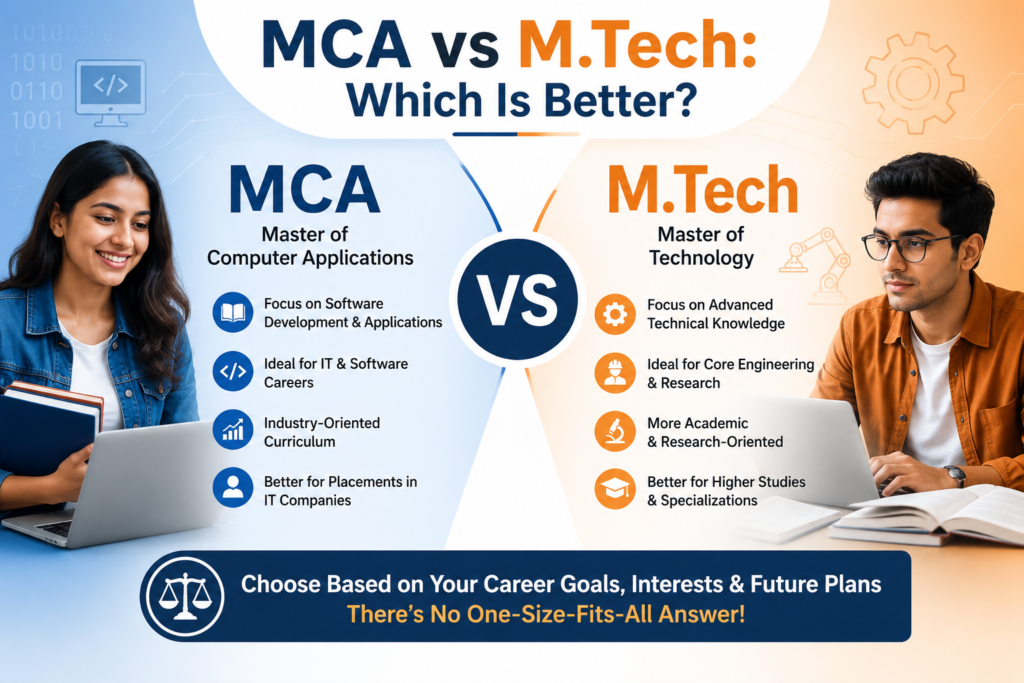
Among the most popular postgraduate options for IT aspirants are the Master of Computer Applications (MCA) and Master of Technology (M.Tech). Both programs offer excellent opportunities, but they are designed for different career goals and educational backgrounds. As a result, many students find themselves asking: MCA vs M.Tech – which is better for a career in IT?
The answer depends on your academic background, career aspirations, interests, and long-term professional goals. Understanding the differences between these programs can help you make an informed decision.
Understanding MCA and M.Tech
Before comparing the two programs, it is important to understand what each degree offers.
What Is MCA?
Master of Computer Applications (MCA) is a postgraduate degree focused on computer applications, software development, programming, and information technology.
The program is designed to provide students with practical and theoretical knowledge in areas such as:
- Software Development
- Database Management
- Programming Languages
- Web Technologies
- Mobile Application Development
- Cloud Computing
- Artificial Intelligence
- Data Analytics
MCA is particularly suitable for students who wish to build careers in software and IT-related industries.
What Is M.Tech?
Master of Technology (M.Tech) is a postgraduate engineering degree that focuses on advanced technical concepts, research, and specialization.
Students can pursue M.Tech in various disciplines, including:
- Computer Science Engineering
- Artificial Intelligence
- Data Science
- Cybersecurity
- Software Engineering
- Information Technology
M.Tech programs generally emphasize technical depth, research, innovation, and advanced engineering concepts.
Eligibility Criteria: MCA vs M.Tech
MCA Eligibility
Students can typically pursue MCA after completing a bachelor’s degree with mathematics as a subject at the 10+2 or graduation level, depending on university requirements.
Common undergraduate backgrounds include:
- BCA
- B.Sc. (Computer Science)
- B.Sc. (IT)
- B.Com
- B.A. with Mathematics
M.Tech Eligibility
M.Tech usually requires a technical undergraduate degree such as:
- B.Tech
- BE
- Equivalent engineering qualification
Many institutions also consider GATE scores during the admission process.
This makes MCA more accessible for students from diverse academic backgrounds.
Curriculum Comparison
MCA Curriculum
The MCA curriculum focuses on industry-oriented skills and practical applications.
Key subjects often include:
- Programming Languages
- Data Structures
- Software Engineering
- Database Systems
- Operating Systems
- Computer Networks
- Machine Learning
- Web Development
Students gain extensive hands-on experience through projects, internships, and practical assignments.
M.Tech Curriculum
M.Tech programs focus more on technical specialization and advanced engineering concepts.
Common areas include:
- Advanced Algorithms
- Distributed Systems
- Artificial Intelligence
- Research Methodologies
- Advanced Software Engineering
- High-Performance Computing
The curriculum often includes research projects and technical dissertations.
Career Opportunities After MCA
An MCA degree opens doors to a wide range of IT careers.
Popular job roles include:
Software Developer
Developing applications, software solutions, and digital platforms for businesses and consumers.
Web Developer
Creating and maintaining websites and web applications.
Mobile App Developer
Designing applications for Android and iOS platforms.
Data Analyst
Analyzing data to support business decisions and improve performance.
System Analyst
Evaluating and improving IT systems within organizations.
Cloud Computing Specialist
Managing cloud infrastructure and deployment solutions.
The MCA degree is highly valued by IT companies seeking professionals with strong software development and programming skills.
Career Opportunities After M.Tech
M.Tech graduates often pursue specialized technical and research-oriented roles.
Career options include:
Research Scientist
Working on technological innovation and advanced computing solutions.
Software Architect
Designing large-scale software systems and frameworks.
Technical Consultant
Providing specialized expertise to organizations.
AI and Machine Learning Engineer
Developing advanced AI-based solutions and intelligent systems.
Academic and Research Careers
Many M.Tech graduates choose teaching or doctoral research pathways.
MCA vs M.Tech: Which Offers Better Job Opportunities?
Both degrees provide excellent employment opportunities, but the nature of the roles often differs.
MCA Advantages
- Strong focus on practical IT skills
- High demand in software development companies
- Wider eligibility criteria
- Faster entry into the IT industry
- Excellent opportunities in startups and multinational corporations
M.Tech Advantages
- Specialized technical expertise
- Strong research opportunities
- Better suited for engineering graduates
- Opportunities in advanced technology domains
For students aiming to enter software development, application development, IT consulting, and corporate technology roles, MCA often provides a direct and practical career pathway.
MCA vs M.Tech: Salary Comparison
Salary depends on several factors, including:
- Skills
- Experience
- Specialization
- Industry demand
- Employer
Both MCA and M.Tech graduates can secure competitive salary packages.
Professionals with expertise in:
- Artificial Intelligence
- Cybersecurity
- Data Science
- Cloud Computing
- Full-Stack Development
are particularly sought after in today’s technology-driven market.
Ultimately, individual skills and practical experience often have a greater impact on salary than the degree title alone.
Which Degree Is Better for the Future?
The future of IT is driven by innovation, digital transformation, automation, and emerging technologies.
MCA graduates are well-positioned for careers involving:
- Software Development
- Cloud Technologies
- Web and Mobile Applications
- Data Analytics
- IT Management
M.Tech graduates are often better suited for:
- Research and Development
- Advanced Engineering Roles
- Specialized Technology Domains
- Academic Careers
Students should choose a program based on their interests rather than solely on perceived career advantages.
Factors to Consider Before Choosing
Before deciding between MCA and M.Tech, ask yourself:
What Is Your Educational Background?
Engineering graduates may naturally align with M.Tech, while students from computer applications and related fields often prefer MCA.
What Are Your Career Goals?
If you want to work in software development and IT services, MCA may be ideal.
If you are interested in advanced research and technical specialization, M.Tech could be a better fit.
Do You Prefer Practical Learning or Research?
MCA focuses heavily on practical applications, whereas M.Tech often emphasizes technical depth and research.
What Industry Role Do You Envision?
Your desired job role should influence your academic choice.
Choosing the Right Institution Matters
Whether you choose MCA or M.Tech, the quality of education plays a crucial role in career success.
Students should look for institutions that offer:
- Experienced faculty
- Industry-oriented curriculum
- Modern computer laboratories
- Internship opportunities
- Placement assistance
- Industry collaborations
Many students searching for the Best MCA College In India, Best MCA College In Agra, or among the Best MCA Colleges prioritize institutions that combine academic excellence with practical industry exposure to prepare graduates for evolving IT careers.
Conclusion
Both MCA and M.Tech are valuable postgraduate programs that can lead to successful careers in the IT industry. The right choice depends on your academic background, professional aspirations, and preferred career path. MCA is often ideal for students seeking practical software development and IT careers, while M.Tech is better suited for those interested in advanced technical specialization and research. With a strong curriculum, experienced faculty, and industry-focused learning environment, RBSMTC helps students develop the technical expertise, problem-solving abilities, and professional skills needed to succeed in today’s rapidly evolving technology landscape.